
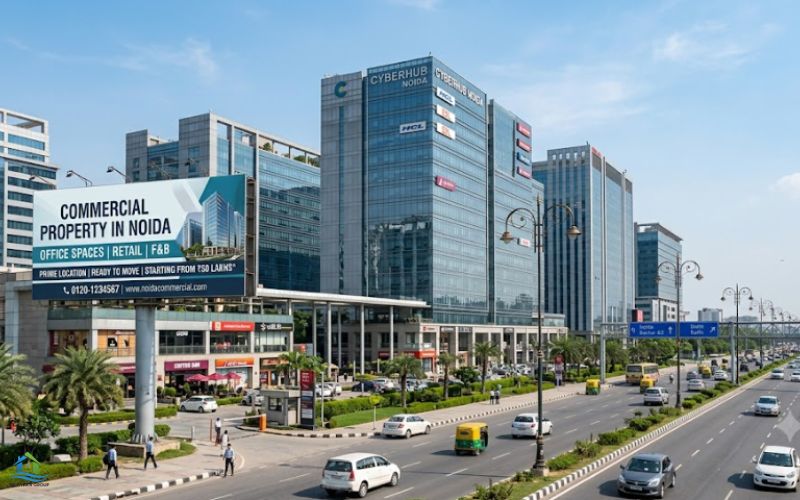
Noida has changed considerably over the past decade. What was once known mainly as a planned residential and industrial city has developed into an important business destination in the Delhi-NCR region. IT companies, corporate offices, retail brands, educational institutions, healthcare facilities, entertainment centres and new residential communities have all contributed to this transformation. As a result, demand for Commercial Property in Noida has grown among business owners as well as investors looking for income-producing real estate.
But buying a commercial property is not the same as purchasing a home. A good-looking shop or office does not automatically make a good investment. Location, customer movement, tenant demand, access, parking, building quality, lease terms, surrounding development and the financial health of the project all matter.
For an investor, the right question is not simply, “How much will this property appreciate?” A better question is, “Who will use this property, why will they choose this location, and what will make them continue paying rent?”
That shift in thinking can make a major difference
Noida offers several types of commercial real estate, from high-street shops and office spaces to retail units, food outlets, commercial floors and mixed-use developments. Each category has its own advantages and risks. This guide explains what buyers should examine before making a decision and how to approach the Commercial Property in Noida market with a practical, long-term perspective.
Why Noida Has Become a Commercial Real Estate Destination
One of Noida’s biggest strengths is its planned infrastructure. Wide roads, established residential sectors, office districts, industrial areas and metro connectivity have created a city where different types of economic activity can coexist.
The city’s position within NCR is another advantage. Delhi is close, Ghaziabad is accessible, and Greater Noida has expanded rapidly. This gives businesses access to a large catchment of residents, employees and consumers.
Connectivity is also continuing to evolve. The Noida Metro Rail Corporation lists multiple proposed Aqua Line extensions, including the 17.435-km extension from Sector 51 towards Knowledge Park-V and an 11.56-km extension from Sector 142 to Botanical Garden. Such projects can influence the long-term commercial potential of areas around future transport corridors, although investors should never treat a proposed infrastructure project as a guaranteed return.
Noida Metro Rail Corporation
Another major development is Noida International Airport. Commercial flight operations began on 15 June 2026, initially with domestic services, creating another important transport connection for the wider region.
Noida International Airport
For commercial real estate, infrastructure matters because businesses depend on accessibility. Employees need to reach offices. Customers need convenient access to shops. Suppliers need reliable road connections. Visitors need parking and public transport.
In simple terms, commercial property works best when people have a reason to visit the area and an easy way to get there.
What Makes Commercial Property in Noida Different From Residential Property?
Residential property primarily depends on housing demand. Commercial property depends on economic activity.
For example, an apartment can remain useful even if the surrounding area is relatively quiet because someone lives there. A retail shop, however, needs customers. An office needs businesses and employees. A restaurant needs visibility, access and regular footfall.
This is why the same location can be excellent for one type of commercial property and unsuitable for another.
Consider two properties on the same road. The first is a small ground-floor shop facing a busy internal market. The second is a large office on an upper floor with limited signage. A grocery store may perform well in the first location but struggle in the second. A consultancy firm may have the opposite preference. Therefore, investors should begin with the intended use rather than the property itself.
Ask:
- Who is the likely tenant?
- Who are the customers?
- How frequently will people visit?
- Is the property visible from the main road?
- Is parking sufficient?
- What businesses already operate nearby?
- Is the surrounding population growing?
- How easy is the location to reach by metro and road?
- Can the property be leased without major modification?
- These questions are often more valuable than simply comparing the price per square foot.
Major Types of Commercial Property in Noida
The term commercial property covers several different formats. Understanding the differences helps buyers choose an asset according to their budget and investment objective.
1. Retail Shops
Retail shops are among the most visible commercial assets. They can include grocery stores, salons, pharmacies, apparel outlets, cafés, restaurants, electronics stores and service businesses.
Ground-floor shops with good frontage generally receive more attention because customers can see and enter them easily.
However, high visibility alone does not guarantee success. A shop selling premium products in an area with limited spending power may struggle despite excellent frontage.
For retail investors, the surrounding catchment is critical.
2. Office Spaces
Noida has established itself as an office destination, particularly for IT, technology, business services, consulting, finance, back-office operations and other professional activities.
An office investment can provide rental income when the building has the right combination of connectivity, amenities, parking, security and professional surroundings.
The tenant profile also matters. A property designed for corporate occupiers may have different requirements from one suitable for small businesses.
3. Food and Beverage Spaces
Restaurants, cafés and quick-service outlets require a different approach.
A restaurant may need strong evening footfall, while a café near offices may depend heavily on weekday customers. A family restaurant may perform better in a residential catchment.
Before buying an F&B-oriented commercial unit, investors should examine exhaust provisions, electricity load, water supply, parking, service access and the building’s permitted usage.
4. High-Street Commercial Spaces
High-street projects attempt to recreate the shopping experience of a traditional market with organised infrastructure.
Their success depends heavily on tenant mix. A project with complementary businesses can generate stronger customer movement than one with unrelated or vacant units.
For example, a high-street development containing a café, pharmacy, salon, convenience store and daily-needs retailer may create repeat visits because customers have several reasons to come back.
5. Mixed-Use Commercial Developments
Mixed-use developments combine different functions, often including retail, offices and residential components.
These projects can benefit from an in-built customer base, particularly when residents live above or close to the commercial area.
Still, buyers should not assume that every resident automatically becomes a customer. Internal planning, access restrictions, competing retail areas and tenant selection can influence actual business performance.
Choosing the Right Noida Location
Location is the most repeated phrase in real estate for a reason, but it should be interpreted carefully. Instead of asking whether a sector is “prime,” examine what makes it commercially useful.
A location with established residential density can support daily-needs retail. A location surrounded by corporate offices can be more suitable for cafés, restaurants, convenience stores and employee-oriented services. Areas near educational institutions can attract food outlets, stationery stores, coaching centres and convenience businesses.
For office investments, access to major roads and public transport may be more important than traditional retail footfall.
When evaluating Commercial Property in Noida
Immediate Catchment
This is the area within a short walking or driving distance of the property. Look at the number of homes, offices, schools, institutions and existing businesses.
Secondary Catchment
This includes customers who may travel from nearby sectors or neighbourhoods. Road connectivity becomes more important at this level.
Wider Catchment
This refers to customers travelling from other parts of Noida, Greater Noida, Delhi or Ghaziabad. Major roads, metro connectivity and destination value become more relevant. A successful commercial location usually has a clear reason for people to travel there.
Commercial Property in Greater Noida: Should Investors Consider It?
The growth of Greater Noida has created another commercial real estate market alongside Noida. Buyers considering commercial property in Greater Noida should understand that the investment logic can differ from established Noida sectors.
Greater Noida has larger planned areas, expanding residential developments, educational institutions, industrial activity and major infrastructure projects. Some locations may offer more space or lower entry prices than established commercial pockets in Noida.
The trade-off can be maturity
An established commercial location may already have tenants and regular customers. A developing location may depend more heavily on future population growth and infrastructure completion.
Neither is automatically better
For example, suppose an investor buys a retail unit in an established market at a higher price. The property may have stronger immediate rental demand. Another investor buys a lower-priced unit in a developing corridor. The second property may eventually perform very well, but the investor may need to wait longer for the surrounding catchment to mature.
The choice should depend on investment horizon, cash flow requirements and tolerance for development risk.
How to Evaluate Rental Potential
Rental income is one of the main reasons investors choose commercial real estate.
But advertised rent and actual achievable rent can be very different
Suppose a property is advertised at ₹80,000 per month. That number looks attractive until you discover that comparable occupied units are achieving ₹60,000–₹65,000. If the property remains vacant for several months, the expected annual return changes considerably.
A practical rental assessment should include:
- Current rents for comparable properties
- Vacancy levels in the building
- Typical lease periods
- Security deposit practices
- Maintenance charges
- Property taxes and other recurring costs
- Fit-out requirements
- Tenant demand
- Time normally required to find a tenant
- For investment analysis, calculate the annual income after considering vacancy and operating expenses rather than using the headline monthly rent.
Capital Appreciation Is Not Guaranteed
Commercial property can appreciate when an area becomes more desirable, infrastructure improves, supply remains controlled and businesses increasingly prefer the location. But appreciation is not automatic.
A property bought at an inflated price may take years to catch up. A project with excessive supply may experience weak rental growth even when the broader city is expanding.
Investors should therefore consider two separate returns:
- Income return: money generated through rent.
- Capital return: increase in property value over time.
- A balanced investment decision considers both.
Check RERA and Project Documents Carefully
Documentation should never be treated as a formality. UP-RERA provides online tools for project registration and verification. Its current portal allows buyers to verify RERA registration details, and its registration framework covers commercial projects as a distinct category.
UP RERA
Before buying a commercial unit, buyers should verify the applicable project registration, promoter details and available approvals.
Depending on the property, documents may include:
- RERA registration details, where applicable
- Approved building plans
- Land title and ownership documents
- Development or lease documents
- Completion or occupancy-related approvals, as applicable
- Fire and safety approvals where applicable
- Commercial-use permissions
- Utility arrangements
- Maintenance and association documents
- Sale agreement and payment schedule
- A professional legal review is worthwhile, especially for a high-value transaction.
Do not rely only on brochures or verbal assurances
Understand the Difference Between Carpet Area and Saleable Area
Commercial property advertisements can sometimes present large numbers that make a unit appear more spacious than it actually feels. Ask for a clear area statement.
Understand:
- Carpet area
- Built-up area
- Common-area loading
- Saleable or super built-up area
- Usable frontage
- Storage or service areas
- Two properties with the same quoted size can have noticeably different usable spaces.
For a retail business, even a few feet of additional frontage can influence visibility. For an office, usable floor area can affect how many employees can comfortably work there.
Parking Can Make or Break a Commercial Investment
Parking is often underestimated during property selection. A restaurant may look attractive on paper, but if customers cannot find parking, they may choose another destination. The same issue can affect clinics, salons, retail stores and professional offices.
Ask practical questions:
- Is parking dedicated or shared?
- How many spaces are realistically available?
- Is there visitor parking?
- Are parking charges applicable?
- Can delivery vehicles access the property?
- Is the parking arrangement documented?
Never assume that a verbal promise about parking will automatically become a permanent right.
Footfall Is Important, But Quality Matters More
High footfall sounds attractive, but the right kind of footfall is what matters. Imagine a property receives 5,000 passers-by each day, but only a small percentage are potential customers for the businesses operating there. Another location may receive 1,500 people, but most belong to the target customer group.
The second location could perform better
This is why investors should study customer profiles rather than relying solely on footfall numbers.
Spend time at the property during different periods:
- Morning
- Afternoon
- Evening
- Weekdays
- Weekends
- Observe who actually visits the area
A ten-minute site visit is not enough to understand a commercial location.
Check Existing Tenants Before Buying
If the property is already leased, the existing tenant can provide valuable information.
Review the lease agreement and understand:
- Monthly rent
- Lease duration
- Escalation clause
- Security deposit
- Lock-in period
- Renewal terms
- Maintenance responsibility
- Termination conditions
- Rent payment history
- A property with a reliable tenant and a clear lease structure can offer more predictable income.
However, an occupied unit is not automatically a good investment. If the rent is significantly below market level or the tenant has weak financial capacity, the apparent security may be misleading.
Common Mistakes Buyers Make
Buying Because the Price Looks Low
A low price can indicate an opportunity, but it can also reflect weak demand, poor access, legal issues or excessive supply. Always ask why the property is cheaper.
Choosing a Property Solely on Future Development
Future infrastructure can improve an area, but timelines can change. Buy based on today’s fundamentals and treat future development as an additional advantage rather than the only reason for the investment.
Ignoring Vacancy
Commercial property can remain vacant for longer than residential property, depending on location and asset type. Maintain enough financial reserves to handle vacant periods.
Assuming Every Ground-Floor Shop Is Valuable
Ground-floor visibility helps, but tenant suitability, frontage, access and surrounding businesses still matter.
Not Checking Maintenance Costs
A property with attractive rent may become less appealing when maintenance and common-area expenses are high.
Depending Entirely on a Broker’s Return Projection
A professional broker can provide useful market information, but investors should independently verify rent, comparable transactions, documents and project approvals.
How a Real Estate Company Can Help Buyers
A reliable real estate company should do more than show properties. The better approach is to first understand the client’s objective.
An investor seeking monthly income may need a different property from an entrepreneur planning to operate a business personally. Similarly, someone with a five-year investment horizon may choose differently from someone planning to hold the property for fifteen years.
A professional advisory process should include:
- Understanding the buyer’s budget and objective.
- Shortlisting suitable locations.
- Comparing property formats.
- Reviewing rental potential.
- Checking project and property documentation.
- Comparing competing properties.
- Estimating total acquisition cost.
- Assessing exit potential.
- Supporting negotiations.
- Coordinating with legal and financial professionals where required.
- The goal should be to help the buyer make an informed decision, not simply close a transaction.
How Much Budget Should You Allocate?
There is no single ideal budget for commercial real estate. Instead, buyers should calculate the complete acquisition cost.
This can include:
- Property price
- Stamp duty
- Registration expenses
- Applicable taxes
- Brokerage
- Legal due diligence
- Interior or fit-out expenses
- Furniture
- Signage
- Utility deposits
- Maintenance deposits
- Financing costs
For example, if the anticipated rent barely covers the loan payment, even a few vacant months can create financial pressure. A sensible investment plan leaves room for unexpected expenses.
Financing a Commercial Property
Commercial property financing can work differently from home loans. Interest rates, loan-to-value ratios, tenure and eligibility depend on the lender, borrower profile and property. Before signing a purchase agreement, obtain clarity on financing.
Ask the lender:
- What percentage of the property value can be financed?
- What is the applicable interest rate?
- What is the loan tenure?
- What processing fees apply?
- Are there prepayment conditions?
- What documents are required?
- Does the specific project qualify for financing?
- Loan eligibility should be established before making an irreversible financial commitment.
What Should Investors Look for Over the Next Few Years?
Noida’s commercial outlook is closely connected to infrastructure, employment growth, residential expansion and the wider NCR economy.
The operational Noida International Airport adds a new regional connectivity factor, while planned metro extensions may improve access across parts of Noida and Greater Noida over time.
Noida International Airport
However, investors should avoid making decisions based on headlines alone. Infrastructure creates potential. Businesses create actual commercial demand.
A new road or metro station becomes valuable to commercial property when it improves access for people who have a reason to use the property. That distinction is important.
A Practical Due-Diligence Checklist
Before finalising any Commercial Property in Noida, use this checklist:
Location
- Is the property easy to reach?
- Is the surrounding catchment established or developing?
- What businesses already operate nearby?
- Is the area active at the time of day relevant to the intended business?
Property
- What is the carpet area?
- What is the usable frontage?
- Is the property suitable for the intended business?
- Is there sufficient parking?
- Are power, water and other utilities adequate?
Financials
- What is the total acquisition cost?
- What is the realistic market rent?
- What are maintenance expenses?
- How much vacancy can be expected?
- What is the estimated net yield?
Legal
- Is the title clear?
- Is RERA registration applicable?
- Are approvals available?
- Is commercial use permitted?
- Are the sale and lease documents properly reviewed?
Exit
- Who is likely to buy this property later?
- How liquid is the location?
- Is there a strong tenant market?
- Are comparable properties being sold regularly?
- This checklist can prevent many expensive mistakes.
Final Thoughts
The opportunity in Commercial Property in Noida is not based on one factor. It comes from the combination of location, infrastructure, business activity, population growth, connectivity and the ability of a property to generate genuine commercial demand.
That is why two properties located only a few kilometres apart can deliver very different results.
The best investment is not necessarily the most expensive property, the newest project or the one with the biggest promised return. It is the property whose location, pricing, tenant demand, documentation and long-term purpose make sense together.
For buyers, the process should begin with clarity
Decide whether the objective is rental income, business use, capital appreciation or a combination of these. Define the budget. Study the location at different times. Compare actual rents. Check documents. Understand all additional costs. Then negotiate from facts rather than excitement.
Noida’s commercial market is becoming more connected and more diverse. With the airport now operating and further metro connectivity planned, the wider region is entering another stage of infrastructure-led development.
Noida International Airport
For a serious buyer, that creates opportunities—but also makes careful selection more important.
A well-chosen Commercial Property in Noida can become more than a piece of real estate. It can provide a business location, a recurring income stream and a long-term asset. The key is to buy based on real demand rather than promises.
That is where experienced real estate guidance can make the difference: not by telling buyers what to purchase, but by helping them understand why a particular property may—or may not—make sense for their financial goals.
I’ve kept the article in a publishable, expert-led format and used current official information from UP-RERA, NMRC and Noida International Airport. If you want, I can also turn this into a more aggressively SEO-focused version with SEO title, meta description, H1/H2/H3 structure, FAQs, internal-link suggestions, and a more controlled keyword density.